
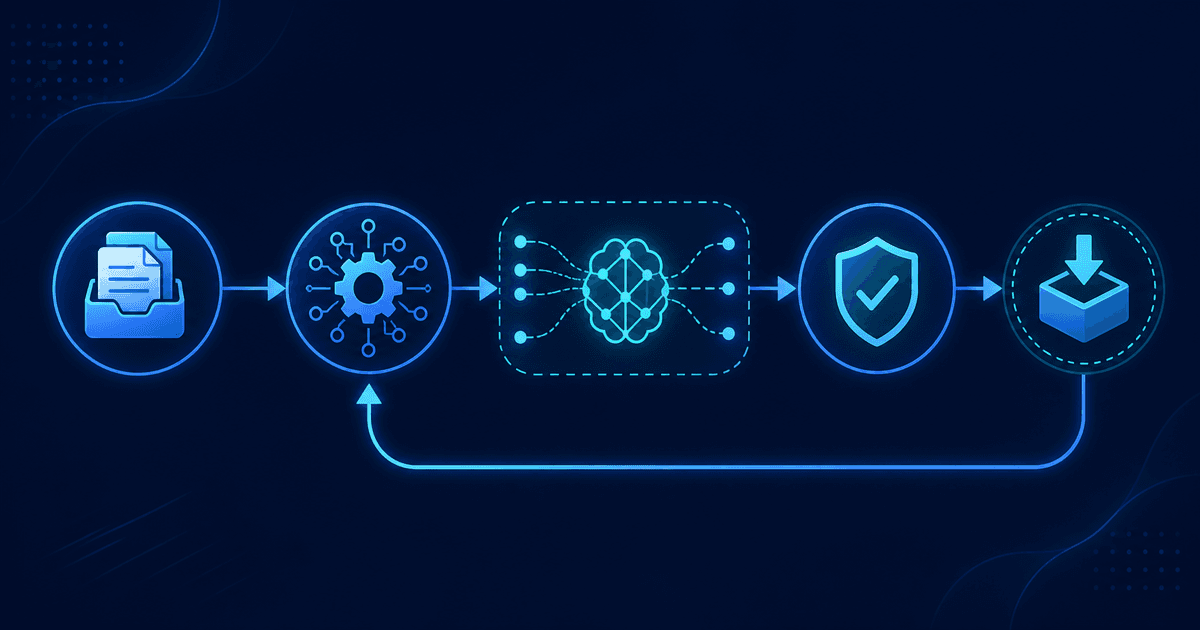
RPA to AI Agent Automation: Run a Controlled 4-Week Migration Pilot
A practical four-week plan for adding AI decisions to an RPA workflow without expanding authority blindly. Define exception classes, approvals, action contracts, evaluation, rollback, and replay before replacing the bot.
Problem definition
Moving a fragile RPA bot to an AI agent is not a model upgrade. It changes how the workflow interprets exceptions, who can authorize actions, and how the team returns to a known-safe process.
Use this guide for a workflow that starts with unstructured input such as an email, PDF, or support request and ends in a constrained internal action. Do not use it to automate irreversible payments, regulatory decisions, or production changes without a separate control design.
Recommendation: add an AI decision lane before replacing the bot
Keep deterministic RPA for stable screens and fixed rules. Add an AI decision lane only where the input is variable and a person can review uncertain cases before an external side effect occurs.
This is a good fit when a team spends time routing messages, extracting fields from documents, or matching requests to existing policies. It is a poor fit when the task already has a low exception rate, one wrong action is costly, and the source data is structured.
System breakdown: separate interpretation from execution
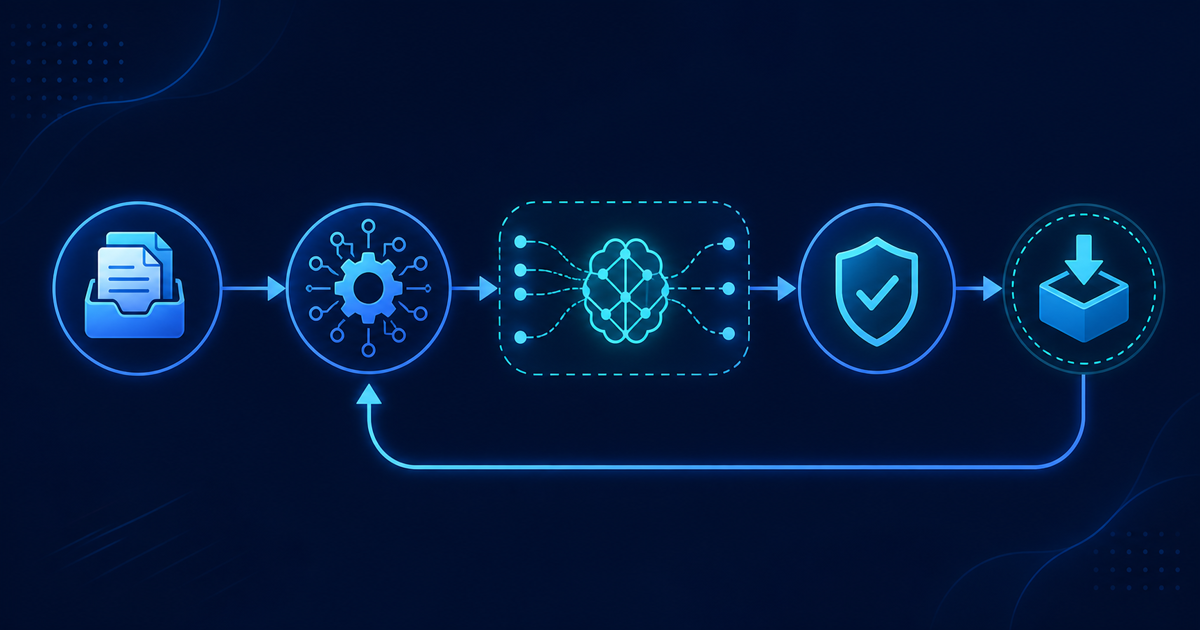
A safe first version has five parts. The intake service stores the original item and assigns a correlation ID. A rules layer handles known cases. The AI service returns a structured recommendation, evidence references, and a confidence band. An approval queue decides whether execution is allowed. The existing bot or API performs the permitted action and records the outcome.
Do not let the model call a broad production credential directly. Give the execution layer a narrow action contract, such as create_draft_ticket or request_vendor_match, with an idempotency key and an explicit dry-run mode.
Why this design is worth the extra work
RPA is predictable because it follows a specified path. An AI component is useful because it can interpret variation, but its output is not a permission grant. Separating interpretation from execution lets the team improve prompts or models without silently expanding operational authority.
UiPath's current Maestro guidance explicitly supports escalation handles for cases an agent should not decide alone. Microsoft Power Automate describes approvals as a way to combine automated sign-off requests with human decision-making. These are product-specific mechanisms, but the operational rule is broader: uncertainty should become a queued decision, not an invisible retry.
Compare the three practical options
| Option | Best for | Cost of change | Main risk |
|---|---|---|---|
| Keep RPA and fix selectors | Stable forms and explicit rules | Low to medium | Continued breakage when the UI changes |
| AI-assisted review | Unstructured intake with a human approver | Medium | Review queue becomes a bottleneck |
| Bounded AI agent with tools | Repeated exceptions with a reversible internal action | Medium to high | Authority grows faster than evaluation coverage |
Start with AI-assisted review. Move to bounded execution only after the team has measured the error classes and proven that a rollback works under realistic failures.
A four-week execution plan
Week 1: choose one exception class
Select a single exception that is common enough to observe but safe to route manually. Write the current rule, the intended outcome, prohibited actions, owner, and fallback. Capture 30 to 50 historical items only if your data policy allows it; remove sensitive content before using it for evaluation.
Week 2: define the contract and evaluation set
Make the AI output a schema, not prose. For example: {route, evidence_ids, confidence, needs_review}. Build a labelled set with accepted, rejected, and ambiguous examples. Record the exact policy version used for each expected result.
Week 3: run in shadow mode
Let the system produce recommendations without acting. Compare each recommendation with the human outcome. Review false approvals, false rejections, missing evidence, and schema failures separately; one aggregate accuracy number hides the recovery work.
Week 4: enable one reversible action
Permit a low-impact action only when the schema is valid, policy checks pass, and the risk band is below the agreed threshold. Route every other case to approval. Rehearse the fallback: disable the AI lane, replay the queue from the correlation ID, and use the original RPA path or manual process.
Example control flow
if rule_matches(item):
  execute_deterministic_action(item)
else:
  recommendation = classify_to_schema(item)
  if recommendation.invalid or recommendation.needs_review:
    enqueue_for_approval(item, recommendation)
  elif policy_allows(recommendation.route):
    execute_reversible_action(idempotency_key=item.id)
  else:
    enqueue_for_approval(item, recommendation)
The important control is not the classifier. It is the point where an invalid or uncertain result stops before execution.
Cost and operating conditions
Budget for more than model tokens. The first pilot needs labelled examples, review time, audit logging, retries, and a workflow owner who can change the policy. If the queue is small and exceptions are rare, the operational overhead can exceed the value of automation.
Track: reviewed items, valid-schema rate, false approval rate, false rejection rate, median review time, replay success rate, and the percentage of actions completed through the fallback. NIST's AI Risk Management Framework organizes risk work around Govern, Map, Measure, and Manage; these metrics give that framework a concrete workflow boundary.
Pitfalls and recovery
- Replacing the bot before measuring exceptions. Recovery: return to shadow mode and label the top three failure classes before changing authority.
- Sending model text straight to an action API. Recovery: require a schema validator, a policy check, and an idempotency key between interpretation and execution.
- Using an approval queue as a rubber stamp. Recovery: show the source evidence, policy version, proposed action, and a reject reason in the review screen.
- No replay path after an outage. Recovery: persist the input reference, correlation ID, action state, and fallback owner before enabling the AI lane.
Limits and when not to use this approach
This guide does not make an AI agent reliable enough for every workflow. Do not use it as the sole decision maker for medical, employment, credit, safety, legal, or irreversible financial outcomes. Use a conventional rules engine when the logic is already explicit and changes infrequently.
Do not claim success from a short pilot. A pilot can establish whether the controls work for one bounded exception class; it cannot prove broad business impact or safety across future inputs.
Further study
- UiPath Maestro: Agentic automation and human escalation (accessed 2026-08-16)
- Microsoft Power Automate: Get started with approvals (accessed 2026-08-16)
- NIST AI RMF: Govern, Map, Measure, and Manage (accessed 2026-08-16)
For related implementation patterns, read how to design an AI approval queue, how to set context boundaries for AI workflows, and how to test agent actions in a browser boundary.
Implementation checklist
- One exception class has a named owner and an existing fallback.
- The AI output is schema-validated and stores evidence references.
- Every action is narrow, reversible where possible, and idempotent.
- Uncertain, invalid, and policy-blocked cases enter a visible approval queue.
- Shadow-mode results are compared with labelled human outcomes.
- Rollback and replay have been tested before automatic execution begins.
Definition of done: the team can disable the AI lane, recover every in-flight item from its correlation ID, and explain why each executed action passed the policy checks.
PUT THE IDEA TO WORK
Practical AI tools
Turn a technical decision into a transparent estimate, capacity plan, or evaluation check. No signup required; your inputs stay in your browser.
Explore the free tools →READ THIS NEXT
Continue with a related guide hub
Share this article
Related articles
OpenJarvis Installation Guide 2026: Official Commands, Permission Boundaries, and How to Select a Local AI Agent
Based on the OpenJarvis official repository and documentation, we have summarized how to safely install, verify, and stop. We also determine cases where local execution is appropriate and cases where a cloud or simple local model runtime is better.

AI Image Provenance Workflow: C2PA, Watermarks, and Human Review
Build an evidence-first image-provenance workflow with original-file retention, C2PA validation, watermark signals, public labels, and a human review path. Use it when an absent signal must remain unknown rather than become a verdict.
Wind Power Forecasting for Operations: Build a Decision Ledger Before You Add AI
A control-first guide to turning wind forecasts into scheduling decisions: issue-time snapshots, uncertainty bands, availability labels, review rules, and safe fallback.
Take the AQ test
See your AI capability in three minutes. Assess recognition, utilization, verification, integration, and ethics at once, then receive practical insights.
Start the free AQ test