
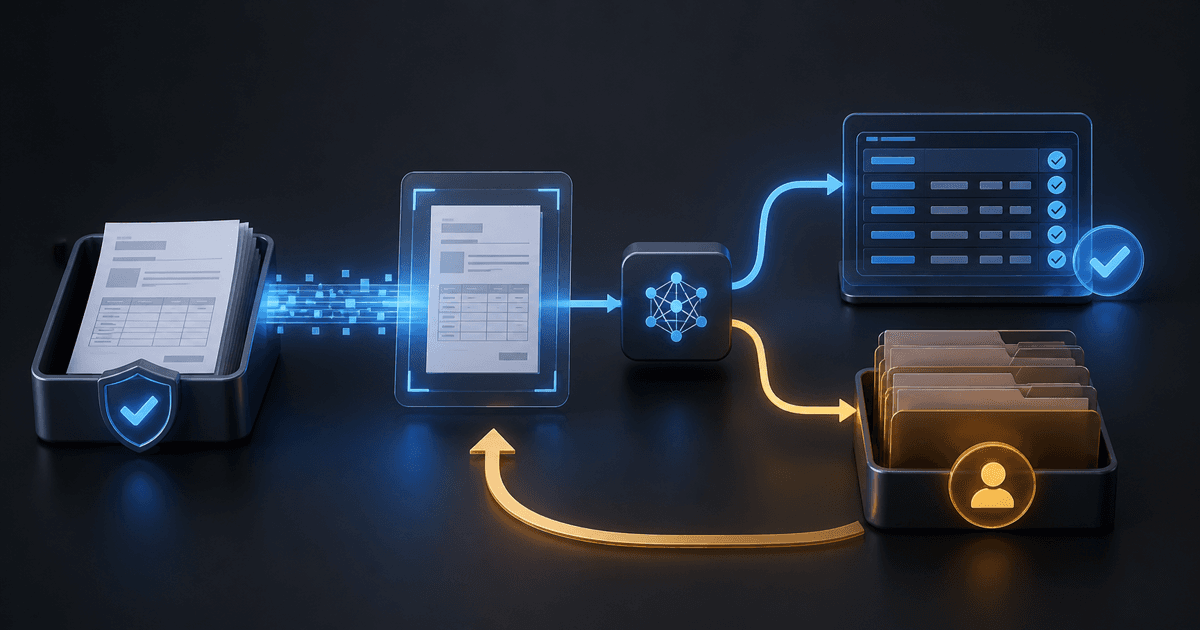
AI Invoice Extraction with Human Review: A Practical Control-First Workflow
Build an AI invoice extraction pilot that turns documents into evidence-backed drafts, routes uncertainty to a human queue, and prevents duplicate financial actions.
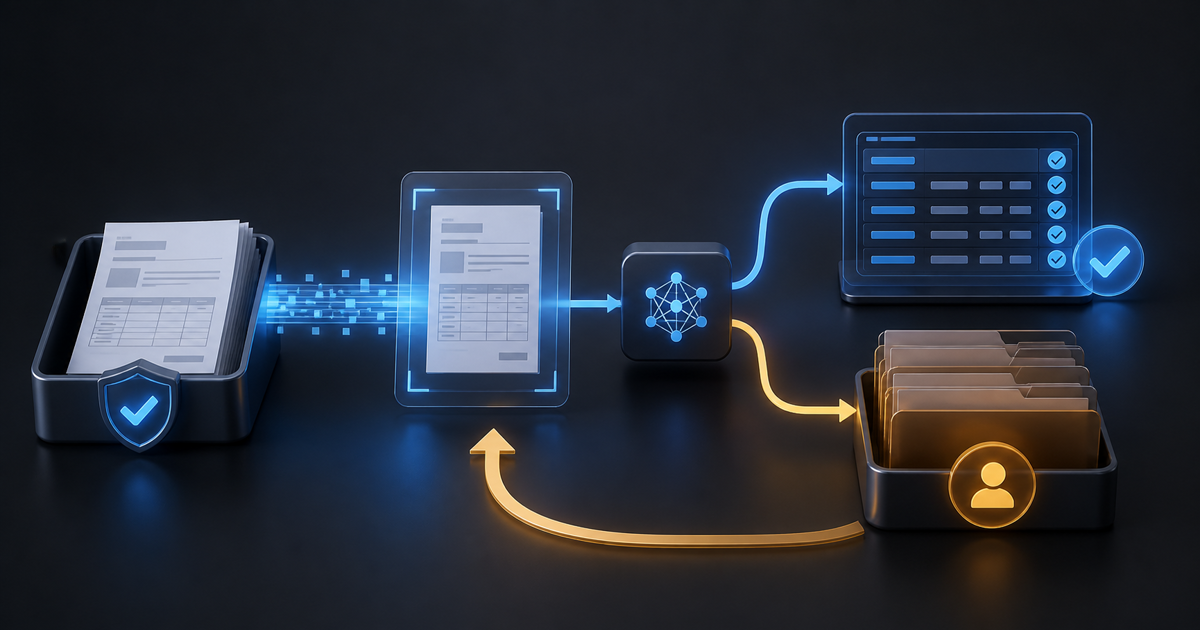
Problem definition: invoice extraction fails at the handoff, not at the upload
Accounts-payable teams often start with a reasonable idea: upload invoices, ask an AI system for a supplier, date, currency, total, and line items, then send the result to an accounting system. The weak point is not reading a clean PDF. It is deciding what to do when the document is incomplete, the purchase order does not match, or a value looks plausible but is wrong.
This guide is for a team that wants to reduce manual data entry without allowing an AI output to create or approve a payable by itself. It is not a guide to replacing tax, procurement, or accounting controls. Those policies remain the source of truth.
Recommendation: automate extraction first; automate posting only after evidence and review controls exist
Use AI to turn a document into a typed draft and to prioritize reviewer work. Keep posting, payment release, supplier creation, and policy exceptions behind deterministic checks and named human approval.
This approach is a good fit when the team already has a document inbox, a payable system, and reviewers who can resolve exceptions. It is a poor fit when invoice images cannot be retained securely, the company has no owner for exception queues, or a vendor is asking for fully autonomous payment decisions.
System breakdown: separate extraction, evidence, validation, and action
A reliable workflow has four layers. They should be observable separately, because a successful model response does not prove that the business action is safe.
- Intake: assign an immutable document ID, store the original file, hash it, and record the sender and arrival time.
- Extraction: use OCR or a document parser to obtain text and page references, then ask a model to return a schema-constrained invoice draft.
- Validation: run deterministic checks for required fields, arithmetic, duplicate invoice number, approved supplier, purchase-order match, currency, and spending policy.
- Decision: route only records that pass every required control to a prepared-draft state. Route all other records to a review queue with the original evidence and the failed rule.
Structured Outputs is useful at the extraction boundary because it constrains the response to a JSON schema. It does not verify that a value is true. A schema can confirm that invoice_total is a number; it cannot establish that the number was read from the right page or belongs to the right supplier.
Design trade-offs: a single confidence score is not a release policy
Do not use “confidence above 90%” as a universal automatic-posting rule. Confidence signals differ by vendor and model, and a high-confidence duplicate can still be a costly error. Instead, set the action rule per field and per control.
| Decision point | Useful signal | Safe action | Do not infer |
|---|---|---|---|
| Supplier identity | Approved vendor ID plus normalized name match | Prepare a draft | That a similar name is an approved supplier |
| Total and currency | Line-item arithmetic and document evidence | Continue validation | That a correctly formatted total is payable |
| Purchase-order match | Exact PO, receipt, and tolerance rule | Route by policy | That a missing PO is harmless |
| Duplicate check | Supplier, invoice number, amount, date, and file hash | Hold for review | That a new file is a new liability |
The trade-off is deliberate. More review lowers straight-through throughput, while fewer controls increase the chance that a polished extraction becomes an incorrect financial action. Start with a narrow draft-creation scope and measure the queue before expanding it.
Step-by-step execution: build a reversible pilot
1. Define the output contract before choosing prompts
Create a versioned schema with nullable fields and evidence pointers. Never force the model to guess a value just to satisfy a required string.
{
  "schema_version": "invoice-v1",
  "supplier_name": null,
  "invoice_number": null,
  "invoice_date": null,
  "currency": null,
  "invoice_total": null,
  "purchase_order": null,
  "evidence": [{"field": "invoice_total", "page": 1, "quote": ""}],
  "needs_review": true
}
For an API-backed extractor, validate the returned JSON against this schema in your application. Reject extra fields and record the model, prompt version, parser version, and request ID. If a schema changes, deploy it as a new version and keep the old reader until queued work is cleared.
2. Preserve page-level evidence
Store the original file once. Store extracted text and layout data separately with page numbers. A reviewer should be able to move from a field in the draft to the relevant page without asking the model to explain itself again.
Use a parser appropriate to the document. Born-digital PDFs, scanned invoices, tables, and image-heavy documents have different failure modes. Unstructured documents its partitioning strategies and trade-offs; test them on your own supplier samples rather than assuming one parser handles every layout.
3. Apply deterministic controls in a fixed order
First validate the data shape. Next check arithmetic and required evidence. Then check vendor, duplicate, and purchase-order rules. Finally apply the company’s approval policy. Keep each result as a named pass, fail, or not-applicable status. Avoid a single opaque “approved” boolean.
if duplicate_match(invoice):
    route("review", reason="possible_duplicate")
elif not arithmetic_matches(invoice):
    route("review", reason="total_mismatch")
elif not approved_supplier(invoice.supplier_id):
    route("review", reason="supplier_not_approved")
elif not policy_allows_draft(invoice):
    route("review", reason="policy_exception")
else:
    create_draft_only(invoice)
4. Make the review queue an operating surface
Show the original document, extracted values, evidence links, failed rules, and permitted corrections in one screen. The reviewer’s action should be explicit: correct, approve draft, reject, or request information. Record who acted, when, and why.
Do not make the queue a dead end. Corrections should become labeled evaluation cases after privacy review. That lets the team distinguish a parser failure, a prompt failure, a vendor-data issue, and a policy exception.
5. Pilot in shadow mode before any integration writes
For two invoice cycles, create drafts in a non-posting environment and compare them with the existing process. Measure field-level correction rate, percentage routed to review, duplicate holds, time-to-resolution, and the number of cases where evidence was missing. Do not use aggregate “accuracy” as the only release metric.
Alternatives: use simpler tools when the document class is stable
| Approach | Best fit | Main limitation |
|---|---|---|
| Rules and templates | Few suppliers with stable machine-readable layouts | Breaks when layouts or language vary |
| Specialized document extraction | High-volume standard invoice fields and a supported region | Requires validation and exception handling anyway |
| Schema-constrained LLM extraction | Mixed layouts, changing fields, and explanatory normalization | Still requires source evidence and deterministic controls |
| Manual entry | Very low volume or highly sensitive exceptions | Slow and difficult to standardize |
Choose the least complex option that meets the document mix and control requirements. An LLM is not automatically a better OCR engine. Its value is usually in normalization, exception explanation, and handling variation after the source text is available.
Cost and operations: budget for exceptions, retention, and reprocessing
Model calls are only one cost. Include OCR or parsing, document storage, queue ownership, integration monitoring, and the cost of replaying failed jobs. Keep an idempotency key based on the immutable document ID, so a retry cannot create a second draft.
Set retention rules with finance and security teams before running a pilot. Invoices can contain personal data and banking details. Limit who can view originals, redact logs where feasible, and keep production documents out of prompt examples and evaluation exports.
Pitfalls and recovery
- Failure: treating valid JSON as verified data. Recovery: require source evidence and deterministic validation for every field that affects an action.
- Failure: retrying a failed job by creating a new payable. Recovery: use an idempotency key and a state machine that resumes the existing record.
- Failure: hiding failures behind a generic confidence score. Recovery: record individual rule outcomes and display the exact failed condition to reviewers.
- Failure: letting reviewers silently correct drafts. Recovery: retain before-and-after values, a reason code, and the evidence page; sample those corrections for evaluation.
- Failure: expanding to payment release after a clean demo. Recovery: keep payment approval outside the workflow until the pilot has documented control performance and an accountable owner signs off.
Limits
This design reduces repetitive entry; it does not resolve supplier disputes, tax interpretation, fraud investigation, or missing procurement policy. It also cannot prove that a genuine-looking invoice is legitimate. Use existing vendor-management, segregation-of-duties, and payment controls for those decisions.
Further study
- OpenAI Structured Outputs documentation (accessed August 15, 2026) explains schema-constrained model responses.
- Unstructured partitioning strategies (accessed August 15, 2026) describes document parsing choices.
- Human approval queue guide for queue states, retries, and escalation boundaries.
- LLM evaluation and drift review loop guide for turning corrections into regression cases.
- Batch and prompt-caching cost guide for separating batch work from time-sensitive requests.
Implementation checklist
- Store the original document, immutable ID, and file hash before extraction.
- Version the extraction schema, prompt, parser, and validation rules.
- Require page-level evidence for action-relevant fields.
- Route duplicate, arithmetic, supplier, PO, and policy exceptions to named review reasons.
- Create drafts only; keep posting and payment release under existing approvals during the pilot.
- Use idempotency keys and replay the same record, not a new one.
- Measure corrections and missing evidence by supplier and document class.
- Review document retention, access, and redaction with security and finance owners.
Definition of done: a pilot record can be traced from source document to extracted evidence, validation results, reviewer decision, and draft outcome, with retries unable to create a duplicate payable.
Editorial judgment: I recommend this workflow for teams that need a controlled way to reduce invoice entry work. I do not recommend it for unattended payment approval or for teams that cannot staff an exception queue. The practical win is not pretending that every invoice is certain; it is making uncertainty cheap to inspect and safe to recover from.
PUT THE IDEA TO WORK
Practical AI tools
Turn a technical decision into a transparent estimate, capacity plan, or evaluation check. No signup required; your inputs stay in your browser.
Explore the free tools →Share this article
Related articles
OpenJarvis Installation Guide 2026: Official Commands, Permission Boundaries, and How to Select a Local AI Agent
Based on the OpenJarvis official repository and documentation, we have summarized how to safely install, verify, and stop. We also determine cases where local execution is appropriate and cases where a cloud or simple local model runtime is better.

AI Image Provenance Workflow: C2PA, Watermarks, and Human Review
Build an evidence-first image-provenance workflow with original-file retention, C2PA validation, watermark signals, public labels, and a human review path. Use it when an absent signal must remain unknown rather than become a verdict.
Wind Power Forecasting for Operations: Build a Decision Ledger Before You Add AI
A control-first guide to turning wind forecasts into scheduling decisions: issue-time snapshots, uncertainty bands, availability labels, review rules, and safe fallback.
Take the AQ test
See your AI capability in three minutes. Assess recognition, utilization, verification, integration, and ethics at once, then receive practical insights.
Start the free AQ test